
BET analysis is a widely used method to determine the specific surface area of powders, porous solids and particulate materials. The technique is based on the physical adsorption of gas molecules on the surface of a solid material. Depending on the material and the selected measurement conditions, gas adsorption can also provide information about pore volume and pore size distribution.
The specific surface area obtained from this analysis is commonly referred to as the BET surface area. It is generally expressed in square metres per gram (m²/g). BET surface area is an important material property in the development, production and quality control of, for example, catalysts, adsorbents, ceramics, pigments, pharmaceuticals, battery materials and nanomaterials.
What is BET analysis?
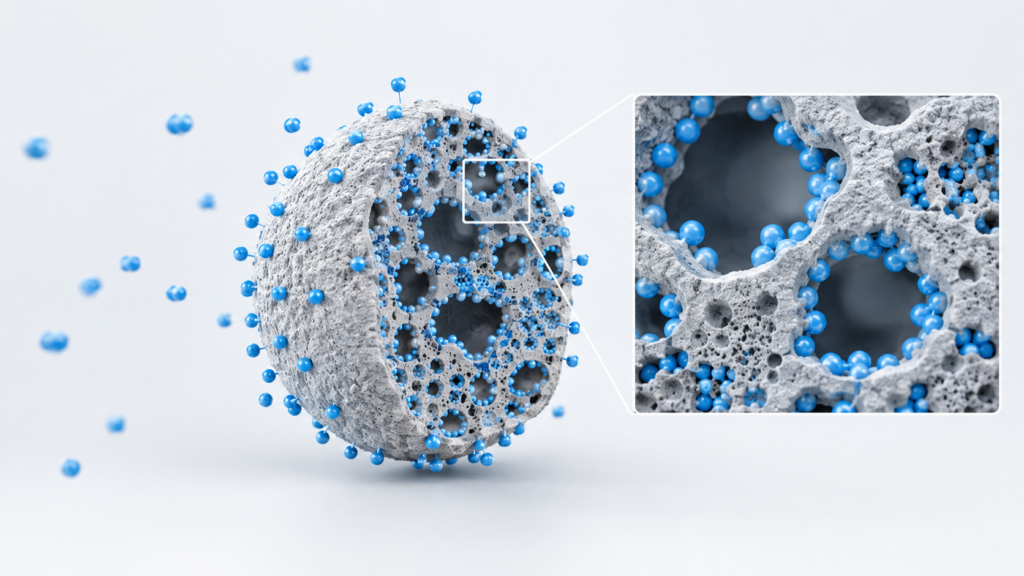
The BET method is named after Brunauer, Emmett and Teller, who developed a model for calculating the amount of gas required to form a monolayer on a solid surface. During the analysis, a known gas is introduced to the sample at a controlled temperature and pressure. Gas molecules adsorb onto the accessible external and internal surfaces of the material.
By measuring the amount of gas adsorbed at different relative pressures, an adsorption isotherm is obtained. A selected section of this isotherm is evaluated using the BET model. The resulting monolayer capacity, together with the assumed cross-sectional area of the adsorbed gas molecule, is used to calculate the specific surface area.
The BET surface area therefore represents the surface that is accessible to the selected gas under the applied measurement conditions. It can include the external surface of the particles as well as the internal surface of pores.
Physical gas adsorption and physisorption
BET analysis is based on physical gas adsorption, also known as physisorption. In this process, gas molecules are held on the surface by relatively weak intermolecular forces. This differs from chemisorption, in which the gas reacts chemically with specific active sites on the surface.
Nitrogen is the most commonly used adsorbate for BET measurements, typically at the temperature of liquid nitrogen, 77 K. However, nitrogen is not suitable for every material or pore structure. Argon can be used when a more accurate characterisation of small micropores is required, while carbon dioxide is often applied to investigate very small pores that may not be adequately measured with nitrogen.
For materials with a very low specific surface area, krypton adsorption can improve the sensitivity of the measurement. The choice of gas should therefore be based on the material properties, expected surface area and pore size range.
What information can be obtained?
A gas adsorption measurement can provide more than a single BET surface area value. Depending on the measurement range and the selected evaluation methods, the analysis can be used to determine:
- BET specific surface area
- total pore volume
- pore size distribution
- adsorption and desorption isotherms
- information about micro-, meso- and, to a limited extent, larger pores
The filling behaviour of a pore depends on its size. Micropores are gradually filled through adsorption, while mesopores can show capillary condensation at higher relative pressures. This pressure-dependent behaviour provides information about the porous structure of the material.
Gas adsorption is particularly suitable for pores in the micro- and mesopore range. The upper pore size range that can be assessed depends on the material and measurement conditions, but gas adsorption is generally not the preferred method for pores larger than approximately 100 nm. Larger pores may be better characterised using another technique, such as mercury intrusion porosimetry.
Sample preparation and degassing
Before the adsorption measurement, the sample is normally subjected to a pre-treatment step, often referred to as degassing or outgassing. The purpose is to remove moisture, solvents and other contaminants from the surface and pores of the material.
The degassing temperature, pressure and duration must be selected carefully. If the treatment is insufficient, contaminants may block part of the surface and result in an underestimated BET surface area. On the other hand, an excessive temperature or prolonged treatment can change the material itself, for example through decomposition, dehydration, sintering or structural collapse.
The appropriate pre-treatment therefore depends on the chemical and physical properties of the sample. For hygroscopic, temperature-sensitive or reactive materials, the sample preparation is an important part of obtaining a reliable and reproducible result.
BET surface area measurement
The BET surface area can be determined using either a single-point or a multipoint BET evaluation. A single-point measurement can be used when a rapid estimate of the surface area is sufficient and the material behaviour is already well understood. A multipoint measurement uses several points from the adsorption isotherm and is generally preferred when a more robust evaluation is required.
The validity of the BET evaluation depends on the selected relative pressure range and on whether the material follows the assumptions of the BET model in that range. This is especially important for microporous materials, where the interpretation of the isotherm requires additional care. The BET result should therefore not be considered independently from the full adsorption isotherm and the properties of the material.
Volumetric and flow methods
Physical gas adsorption can be measured using different instrumental approaches. In a volumetric system, the quantity of adsorbed gas is calculated from pressure changes in a calibrated volume. By measuring adsorption and desorption over a range of relative pressures, a complete isotherm can be obtained. This allows the BET surface area, pore volume and pore size distribution to be evaluated.
A flow-based system determines the amount of adsorbed gas from changes in the gas composition measured by a detector. This approach can be suitable for a fast determination of the BET surface area or total pore volume. Compared with a full volumetric measurement, the amount of structural information obtained is more limited.
The most appropriate measurement method depends on the purpose of the analysis, the expected surface area, the pore structure and the amount of sample available.
Applications of BET analysis
BET analysis is used for the characterisation and comparison of many different types of solid materials. Examples include catalyst supports, activated carbon, zeolites, silica, metal oxides, powders, pigments, ceramic materials, pharmaceutical excipients and electrode materials.
The BET surface area can be related to properties such as adsorption capacity, catalytic activity, dissolution behaviour, reactivity, powder processing behaviour and interaction with liquids or gases. It can also be used to compare batches, monitor material treatments or assess changes caused by drying, calcination, milling or other processing steps.
For nanomaterials, the BET surface area can be combined with density measurements to calculate the volume-specific surface area. This may provide additional information for the characterisation of particulate materials and can be relevant when assessing nanoscale properties.
Interpreting BET results
A higher BET surface area does not automatically mean that a material will perform better in every application. The result should be interpreted together with the pore size distribution, pore volume, particle size, particle morphology and chemical composition.
Two materials can have a similar BET surface area but a different pore structure. Likewise, a material with a high surface area may contain very small pores that are not accessible to a particular molecule during an application. The selected adsorptive gas and measurement conditions can therefore influence the result.
For this reason, the analysis method and sample preparation should be selected according to the material and the question that needs to be answered. Where relevant, BET analysis can be complemented by other techniques, such as mercury intrusion porosimetry, helium pycnometry, particle size analysis or chemical gas adsorption.
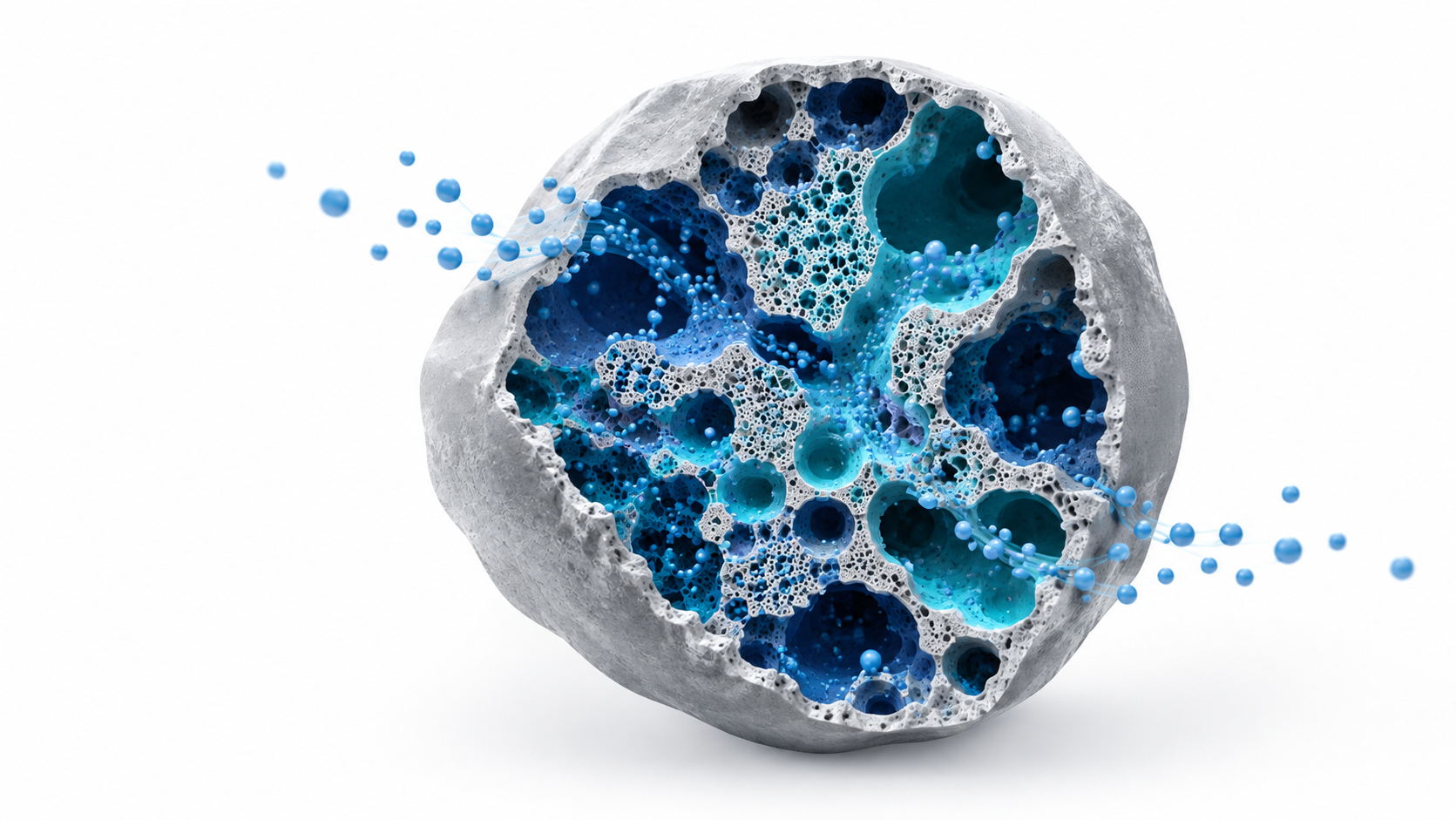
The BET surface area is the specific surface area of a solid material, calculated from a gas adsorption measurement using the model of Brunauer, Emmett and Teller. It is determined from the amount of gas needed to form a single molecular layer (monolayer) on the surface. The result is generally expressed in square metres per gram (m²/g). It represents the surface that is accessible to the selected gas, which includes the external surface of the particles and the internal surface of pores.
A single-point measurement uses one point of the adsorption isotherm. It gives a rapid estimate of the surface area and is suitable when the material behaviour is already well understood. A multipoint measurement uses several points from the isotherm and is generally preferred because it gives a more robust and reliable evaluation. For microporous materials in particular, the selected relative pressure range requires additional care.
Degassing removes moisture, solvents and other contaminants from the surface and pores of the sample. If the treatment is insufficient, these contaminants block part of the surface, which results in an underestimated BET surface area. If the temperature is too high or the treatment too long, the material itself can change, for example through decomposition, dehydration, sintering or structural collapse. The degassing conditions must therefore be matched to the properties of the sample.
Not necessarily. Two materials can have a similar BET surface area but a different pore structure. A material with a high surface area can also contain very small pores that are not accessible to a specific molecule in the intended application. The BET surface area should therefore be interpreted together with the pore size distribution, pore volume, particle size, particle morphology and chemical composition of the material.


