
This page presents an overview of practical powder case studies that we have worked on in the preceding years and which serve as an example for the types of studies that we can work on with you…
We have executed these and similar studies for many different customers active in various markets. Solving complex powder- and particle-related challenges is our daily business!
Do you have a similar challenge ? We definitely believe that we can assist ! Please get in touch with us.

Product loss in a closed pneumatic conveying system
Pneumatic conveying is a widely utilized transport method that requires a fair amount of knowledge not only on the principle of pneumatic conveying, but also on the properties of the conveyed materials; one pneumatic conveying system cannot be universally used to transport every type of materials. Every material comes with …
Read more
Unexpected Charge: Challenges Arising from Electrostatic Effects
During powder processing a lot of particles get in contact with each other and processing equipment, during these contacts several issues may arise. Problems like particle attrition or abrasion, deformation, dust formation, but also electrostatic build up due to triboelectrification. Triboelectrification is the phenomenon where particles get charged after each …
Read more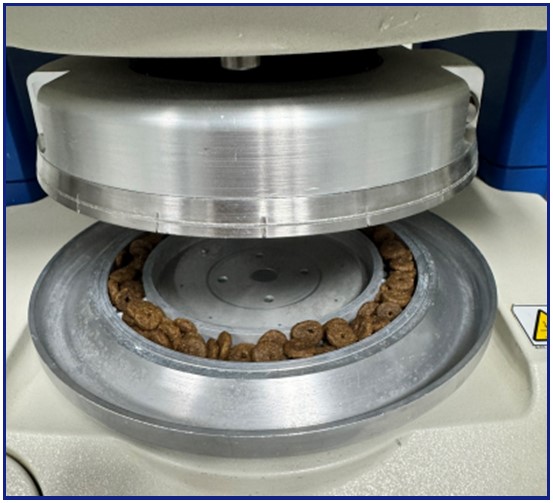
Attrition during granular feed processing
Particle attrition in the process can occur which can cause unwanted fine particles at the end of the process. This is mostly caused for brittle particles and particles with irregular shapes. The definition of fine particles can be different for each product being a few millimeters to sub-micron particles. First …
Read more
Caking of a food preservative
One of the challenges that can occur in powder handling is undesired agglomeration i.e. caking. Caking can result in various problems and in extreme cases significant downtime of the process. The types of materials that exhibit this behaviour can be found in every industry, from food, to construction to pharmacy.
Read more

