
Dustiness formation by handling of powders and particles is often an undesired phenomenon. Obviously, small particles are mostly responsible for dust release, but the effect of attrition and abrasion or the presence or absence of moisture can greatly impact on the dustiness potential of solid materials: dustiness analysis or dust analysis can assist here.
Different methodologies exist to quantify the dustiness potential of products by means of dustiness analysis, either via the Heubach rotating drum dust analysis approach (DIN 55992) or in accordance with the EN 15051 standard employing the continuous drop or rotating drum dust analysis methodology.
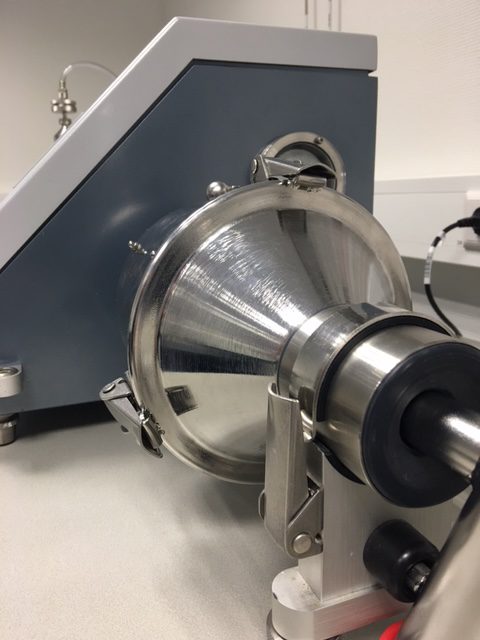
In a typical dust analysis with the rotating drum dust meter, the sample is placed in a drum and handling and conveying is simulated by rotation of the drum. By means of a well-controlled air flow, the dust released is transferred to a sampling section where the total amount of released dust is deposited onto a filter and can be quantified (Heubach) or additional separation into an inhalable, thoracic and respirable fraction can be achieved (EN 15051). The EN 15051 rotating drum methodology also provides information on the fraction of particles with an aerodynamic diameter smaller than 10 micrometers. The dust particulates on the filter are quantified and can be used for further analyses, e.g. particle size analysis, density analysis or assay of a specific ingredient.
The Heubach set-up can be further equipped for a dedicated dust analysis with a type I, type II, or type III supplementary. In case of the type II accessory, the method is referred to as the Stauber-Heubach dustiness potential. This approach is often practised for regulatory purposes associated with food and feed additives, such as dossier submission to the European Food Safety Authority (EFSA). In case of type III an additional attrition component is included by means of stainless steel balls. This type III methodology typically induces a higher dustiness potential and provides information on e.g. the durability of coated enzymes.
The EN 15051 standard also includes a continuous drop dust analysis methodology mimicking the emptying of a storage reservoir thereby inducing a one-time continuous flow of product that can release airborne dust particles and in that way contribute to dustiness formation. This dustiness formation is then classified into an inhalable and respirable fraction.
Further information on dustiness potential research can be found in this dustiness potential article that has been written by Delft Solids Solutions as being a dustiness analysis authority.
Moreover, via this link an article can be downloaded on the application of the Stauber-Heubach dustiness potential measurements to Se-containing feed additives for one of our customers, evidencing its very low dustiness that was originally aimed for.
- Powder Flow and Ring Shear Testing
- Unconfined powder flow testing
- Powder Caking by Uni-axial compact strength testing
- Powder stickiness measurement
- Heubach and EN 15051 dustiness analysis
- Attrition and abrasion of particles, granules and tablets
- Segregation testing of powders and solids
- EN 17199-4 Dustiness index and nano particles
- Oil Absorption Number analysis of carbon black
- Powder conductivity testing
- Tribo Electrostatic charging of powders


