In Photon Correlation Spectroscopy (PCS) or dynamic light scattering (DLS), the Brownian motion (movement in random direction) of nanoparticles or sub-micron particles is measured as a function of time. The technique is based on the principle that smaller particles move with higher velocity than larger particles due to contact with the liquid molecules in which the nano-particles move around.
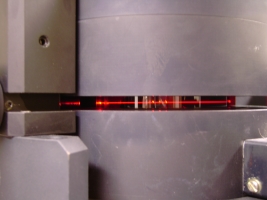
In the dynamic light scattering measurements, a laser beam is diffracted by nanoparticles present in the liquid dispersion. The diffusion of nanoparticles or sub-micron particles causes rapid fluctuations in scattering intensity of the laser around a mean value at a certain angle (varying from 10 to 90°). This intensity fluctuation depends on particle size: smaller particles show fluctuations with higher frequency, whereas larger particles show slower fluctuations.
The correlation function calculated over these fluctuations results in a diffusion coefficient for a given temperature and viscosity, which then can be converted into particle size. The technique is used for determination of the average particle size in a range between approximately 3 and 3000 nanometers. The measurements are performed on a Coulter N4 or Malvern Zetasizer Nano ZS particle size analyzer. Nanoparticle size measurements by means of dynamic light scattering are always executed in a suitable dispersing liquid which can be water both also many different other liquid media can be used, as long as the nanoparticles do not dissolve. In many cases, sample pre-treatment is extremely important in order to obtain a stable nanoparticle dispersion thereby avoiding that the nanoparticles attract each other due to the high inter-particle forces leading to formation of larger agglomerates.
The photon correlation spectroscopy measurements result in an average and mode of the effective hydrodynamic diameter and a polydispersity index, which is a measure for the width of the nanoparticle size distribution.